Getting a self-build mortgage in Ireland
What an Irish self-build mortgage needs: planning permission first, a 10% deposit, borrowing limits, application documents and the interest-only option.
Stage 3: Arrange finance and budget
Budget for your Irish self-build, from site and construction to fees, VAT and contingency. Understand cost averages and compare quotes for your design.
Your self-build budget needs to cover the site, construction, fees, connections, taxes and a contingency for surprises. Get prices against your own drawings and specification; a cost per square metre is useful only when you know exactly what it includes.
The Society of Chartered Surveyors Ireland (SCSI) measured the cost of delivering new houses in private developments in its Cost of New Housing Delivery 2023 report:
This is the cost to a developer delivering houses to the market in private schemes. It includes the land, the developer’s margin and finance, so it is not what a self-builder pays to build on a site they already own, and it describes an estate house, not a one-off design. The 47% share describes that developer sample, not a self-build budget ratio. A self-builder still needs to allow for site, fees, levies, interest and VAT, but does not pay a separate developer margin; contractors and suppliers have their own margins.
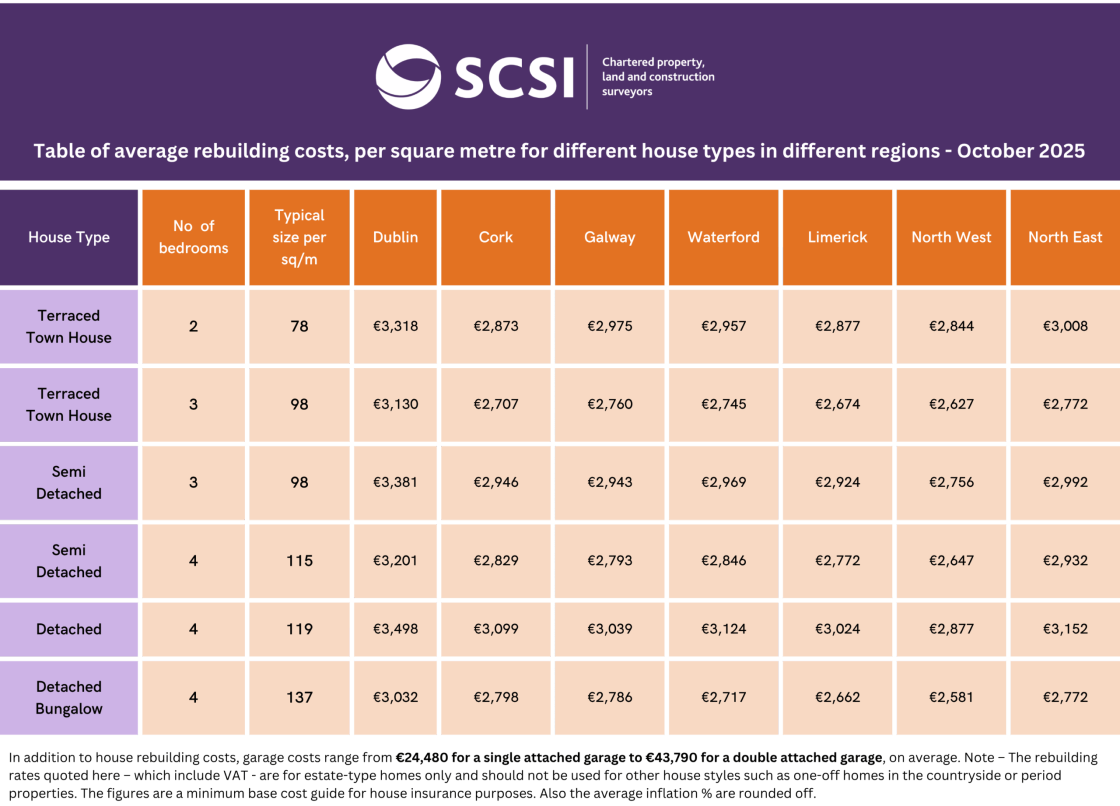
The SCSI also publishes rebuild rates so people can set the sum insured on a house. The 2025/26 guide was published on 4 November 2025. Its figures have a specific purpose:
A rebuild rate allows for professional fees and VAT and assumes a standard house. For your finished self-build, ask a chartered surveyor for a bespoke rebuild estimate so you can set the insurance amount for your actual home. See site and works insurance for the insurance side.
The Central Statistics Office (CSO) tracks changes in materials and labour costs. In the year to May 2026:
Underneath that average, materials moved very differently. These are wholesale prices excluding VAT, May 2026 against May 2025:
| Material | Change in 12 months |
|---|---|
| Ready-mixed mortar and concrete | +8.4% |
| Insulating materials | +7.2% |
| Reinforcing metal | +4.5% |
| Stone, sand and gravel | +4.0% |
| Machined, treated engineered timber | +2.9% |
| Concrete blocks and bricks | +2.1% |
| Rough softwood timber | +1.4% |
| Plumbing materials including sanitary ware | -0.8% |
| Heating, ventilation and air conditioning (HVAC) equipment | -1.1% |
These figures describe May 2026, not a forecast or the latest month. Materials do not all rise at the same rate, and a national index cannot tell you how a contractor will price your job. Ask how long each quote remains valid, what is fixed and what could change before or during construction.
An online range such as “€1,800 to €3,000 per square metre” cannot price your house without a clear specification. Before using any range, check the assumptions behind it:
Two people can quote very different numbers per square metre for the same house, and both can be right about what they included. Compare the scope first, then add the costs outside the quoted price to get your total budget.
List each of these costs and mark it as quoted, estimated or unknown. The unresolved items help you decide how much contingency to hold.
Allow for the purchase price, legal fees, stamp duty, a site survey and ground investigation. Ground conditions can materially change the budget: the foundation design, and so the cost, depends on what the engineer finds. Get ground information before you commit to a design. See site suitability assessments.
Budget for your architect or designer, engineer and a quantity surveyor (a construction cost adviser) if you use one. Where required, include an assigned certifier: the building professional who coordinates inspections and certifies compliance with the Building Regulations. A single dwelling on a single development site can opt out of that formal certification process, but must still meet the Building Regulations. Ask your designer and lender what inspections and evidence they require before deciding. There is no official fee scale for a one-off house, and published quotes vary with scope. Compare what each fee includes, not the percentage. See hiring an architect or engineer and the assigned certifier.
The standard planning application fee for a new house is €65, under Schedule 9 of the Planning and Development Regulations 2001. Retention applications are priced by floor area. The cost that matters is what planning conditions ask you to build or pay. That includes the development contribution your council charges under its own scheme: rates differ by council, so read your authority’s scheme and ask the contributions officer. The temporary waiver for contributions closed to new starts; see the development contribution waiver. Add the cost of the commencement notice, the formal notification to Building Control before work starts, and any certification required under the Building Control (Amendment) Regulations (BCAR).
Use the main contractor’s price, or add the costs of all trades and materials if you project-manage. Break it down by stage, because your lender releases the mortgage against stages. See stages of a self-build.
Check whether these are inside your particular contract:
Details and what to ask for are in site works and services and wastewater treatment systems.
Include the kitchen, flooring, sanitary ware, painting, appliances and wardrobes. These are often priced as allowances in a contract, and an allowance is an estimate until you choose the item. A low allowance for a kitchen is a cost you will meet later.
Construction services are generally charged at 13.5%, but goods and some supply-and-fit jobs are charged at 23%, and the two-thirds rule can affect a combined materials-and-labour supply: where applicable, goods costing more than two thirds of the total VAT-exclusive price make the goods rate apply to the whole transaction. Exceptions include certain construction services between contractors and subcontractors, so confirm the treatment of your own contract. Suppose a contract price for construction work of €200,000 excluding VAT (invented for the arithmetic): at 13.5% the VAT is €27,000 and you pay €227,000. If €20,000 of the €200,000 is materials you buy yourself, VAT on those is 23% (€4,600) rather than 13.5% (€2,700), so your total VAT is €1,900 higher. See VAT on a self-build.
Allow for works insurance and public liability, mortgage interest on drawn stages, valuation and legal costs, and somewhere to live during the build. Confirm the budget, certification and payment schedule your own lender requires before committing to payments. See the self-build mortgage.
Keep a separate contingency for surprises, sized to the costs still uncertain. Do not spend it on upgrades. The next section explains how to size it.
There is no official percentage that makes every project safe. For each cost block, check how much is covered by a firm quote or contract and how much is still an estimate.
Review the reserve as costs become firmer, allowing for exclusions and remaining risks. Spend contingency only on genuine surprises. Decide on upgrades only once the structure is weathertight and the remaining costs are known.
Ask your lender which cost schedule it requires and complete it using VAT-inclusive figures. One lender’s self-build checklist asks for:
That 10% is the minimum on this particular form. It does not establish a suitable reserve for your site, and another lender may require something different. Get your own lender’s requirements in writing.
A budget can balance overall while cash arrives too late for an invoice. Put the lender’s release dates beside the bills, and keep site equity (the value you own in your site, after any loan secured on it) separate from cash available to pay bills. Check stage payments and Help to Buy claim timing before relying on either payment. If a shortfall already exists, work through funding a gap in the build.
The numbers below are invented to show the arithmetic. They are not prices.
| Block | Basis | Example |
|---|---|---|
| Build contract (ex VAT) | quoted | €200,000 |
| VAT at 13.5% | on the contract | €27,000 |
| Services (electricity, water) | invented allowance, obtain offers | €6,000 |
| Wastewater system and works | estimate, pending site assessment | €15,000 |
| Professional fees | quoted | €25,000 |
| Fit-out outside the contract | estimate | €20,000 |
| Site works, entrance, landscaping | estimate | €20,000 |
| Insurance and finance | estimate | €12,000 |
| Subtotal | €325,000 | |
| Contingency | sized to unknowns | €30,000 |
This example excludes the site purchase, its legal/tax costs and planning contributions; add them where applicable. Treat every allowance as VAT-inclusive for this illustration, except the explicitly VAT-exclusive contract. Avoid counting work both inside the contract and again as an outside allowance. The contract including VAT is €227,000, about 70% of the €325,000 subtotal. Budgeting for that contract alone would leave out roughly 30% of the cost, before contingency. Your split will differ, but if your budget is only the contract price, it is incomplete.
The SCSI developer split is not a formula for a self-build. Compare the finished purchase price with your complete project cost, allowing for the value of an already-owned site and avoiding any separate developer-margin allowance:
A self-build may compare more favourably when the site is cheap relative to the area, the design is simple, and you control the specification. The comparison can worsen when the site needs heavy works, the design keeps changing, or the budget has no contingency.
Before you compare two quotes, check these on each:
Cost is one part of the project. For the next steps, see the stages of a self-build, how long it takes and funding a gap in the build.
Your cost depends on the site, design and specification. In 2023, the Society of Chartered Surveyors Ireland measured an average developer delivery cost of €397,000 for a three-bedroom semi-detached house. That includes land, margin, levies and finance, so it does not price your self-build. Get a cost plan and quotes for your own design.
Published per-square-metre numbers on websites vary widely because they assume different specifications, sites and what is included. Insurance rebuild rates from the Society of Chartered Surveyors Ireland are for estate-type houses and should not be used for one-off homes. Get a quantity surveyor's estimate or contractor quotes against your drawings.
It can be, but not automatically. A developer's price includes land, margin and finance, while a self-builder must budget separately for site, fees, taxes and finance and carries the risk of overruns. A self-builder does not pay a separate developer margin. The Society of Chartered Surveyors Ireland found soft costs (land, margin, levies, finance and VAT) were 47% of a developer's delivery cost in 2023. Compare your full budget with the price of a comparable house, not the build contract alone.
Items outside the build contract: site works and entrance, utility connections, wastewater system, professional fees, planning and certification costs, insurance, landscaping and boundaries, and interest or rent during the build. Check each item against your contract so you know what you must pay separately.
Quotes may or may not. Construction services are generally charged at 13.5%, but goods you buy separately and some supply-and-fit jobs can be charged at 23%. Always ask whether a quote includes VAT and at what rate.
There is no official figure. Size it to how much is still unknown: more if the ground is untested or the design is unfinished, less once the main costs are fixed in a contract. Keep the reserve separate and review it as estimates become firm prices.
The Central Statistics Office's Building and Construction Index (materials and wages) rose 3.2% in the 12 months to May 2026, and wholesale prices for construction products rose 3.1%. Individual materials differed: ready-mixed concrete was up 8.4% and insulating materials 7.2%, while heating, ventilation and plumbing materials were slightly down.
Last reviewed 21 October 2026. Rules and figures change, so confirm anything important with the source before you rely on it.
This guide is general information about self-building in Ireland, not financial, legal or insurance advice. Get advice that fits your own situation before you make decisions.