Draft rural housing rules: what the local need test would look like
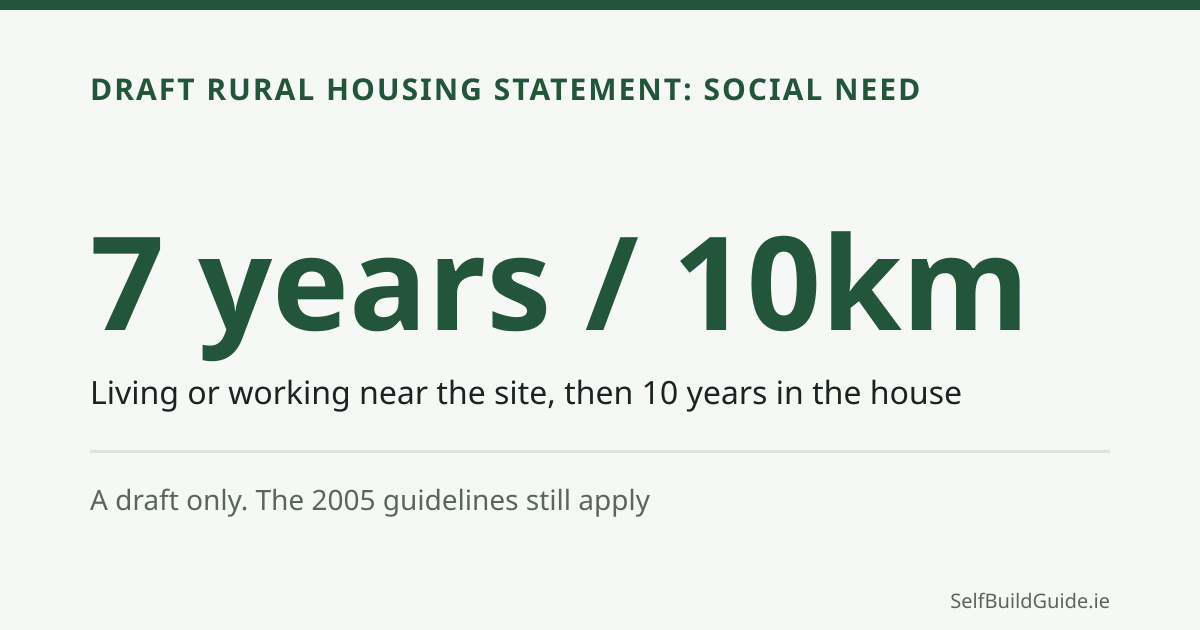
The draft rural housing statement would need 7 years living within 10km and a promise to live in the house for 10 years. The 2005 rules still apply.
In brief
- The Government approved a draft National Planning Statement on Sustainable Rural and Gaeltacht Housing on 30 June 2026. It is a draft. The 2005 guidelines remain in force until a final version replaces them.
- Social need would mean living or working in the local rural area for at least 7 years, continuously or cumulatively, within up to 10km of the site. Returning emigrants are included.
- Economic need covers rural-based work such as farming, or a rural teacher, or a bona fide new rural business. Working remotely for a job based elsewhere does not count.
- Every applicant must intend to occupy the house as a permanent primary residence for at least 10 years, and it must be their first home built in that rural area.
- Development plans should not set caps such as minimum site area, road frontage or a limit on houses per farm or per stretch of road.
- Stricter tests (3km and 10 years) may apply in metropolitan areas and green belts, and 5km and 10 years in high amenity areas. Gaeltacht areas have their own test.
The Government’s draft rural housing statement would replace the 2005 guidelines with a clearer, more uniform local need test. It is a draft, approved on 30 June 2026 for environmental assessment and public consultation. Until a final version is approved, the 2005 guidelines and your county development plan still decide your application.
What would the social need test be?
Under the draft, in areas under urban influence a person shows social need by living, or having lived, in the local rural area for a substantial period. The draft defines that as:
- At least 7 years, continuously or cumulatively, living or working in the local rural area, with close social ties to the community. Returning emigrants and people moving back to where they grew up are included.
- Living in the area within up to 10km of the site.
In metropolitan areas and green belts under heavy pressure, the draft allows a stricter test of 3km and 10 years. In high amenity areas it allows 5km and 10 years. Gaeltacht areas have a separate test of 3km and 10 years, which can fall to 5 years for Irish speakers.
What counts as economic need?
Economic need covers a person whose main work is directly tied to the rural location. That includes farming and other rural-based enterprise, a teacher in a rural school and someone starting a genuine rural business, who must submit a business plan if the enterprise is under 5 years old. Remote working for a job based elsewhere does not count.
A person living or working in a rural settlement of under 1,500 people is treated as having a rural generated housing need.
What else would change?
- You must intend to live in the house as your permanent primary home for at least 10 years, and the council would attach a condition excluding seasonal or short-term letting.
- The house must be your first home built in that rural area, with limited exceptions for exceptional health or personal circumstances backed by medical or legal evidence.
- Development plans should not set numerical caps such as a minimum site area, road frontage, or a limit on houses per landholding or per stretch of road.
- Ribbon development would be judged on its siting, design and environmental merits, with no prescriptive limit on houses per stretch of road.
What should you do now?
Don’t plan around a draft. Your application will be judged against your county development plan and the current guidelines. The rural housing and local need guide explains the test that applies today.
- Keep records of where you have lived and worked, and for how long. They support the test under both the current and proposed rules.
- Ask your planning authority at pre-planning which rules it will apply to your site and when.
- Watch for the public consultation and the final statement before relying on any of the proposed changes.
This article reports a draft policy document. It is not legal advice and the final text may differ.
Sources
Last reviewed 30 June 2026. Rules and figures change, so confirm anything important with the source before you rely on it.
- Draft National Planning Statement on Sustainable Rural and Gaeltacht Housing (June 2026), sections 4.4 and 6.2Department of Housing, Local Government and Heritage (copy hosted on fiannafail.ie)
- There's a new plan for one-off housing - will it make it easier for locals to build in their area?TheJournal.ie
- Draft National Planning Statement on Sustainable Rural and Gaeltacht Housing discussion, 22 September 2026Houses of the Oireachtas
News articles describe what was announced or published on the date shown. They are general information, not financial, tax or legal advice, and measures announced in a Budget may change before they become law.